
The Seldom, №15
Unsober yammering, unpublished fiction, uneasy legacies

Such ugly times. Bigotry and violence are ascendent. Some days, it all looks hopeless. As Stevie Wonder once sang, love’s in need of love today. If there’s one lesson I wish I could oblige certain folks to learn, it would be this: “Through love, any part of any person can become precious.”
In the tradition of periodicals whose names indicate their frequency of publication (Publishers Weekly, The Atlantic Monthly, Lapham’s Quarterly…), I bring you The Seldom. My name is Dale Stromberg, and you’re reading this newsletter because you signed up for it, or else because you’re peeking over the shoulder of someone who signed up for it, which is a nosy thing to do, but I cannot blame you because I have done it too.
Whistle-Wetted Booktalk
I was interviewed by the amiable William R. Hincy for the Writers Drinking Whiskey podcast. You can view it here. The interview was conducted back in May 2025, but the release got pushed out, presumably because 2025 was 2025. One thing we all needed last year was a stiff drink, and that’s the concept of the show (getting pickled and talking nonsense), so I grabbed a bottle and got to work.
Since this was recording many months ago, I can scarcely recall what I said. In fact, I got considerably into the spirit (i.e. imbibed spirits considerably), which means that, the very morning after, I could scarcely recall what I’d said. While the recording was in progress, I likely had little idea what I was saying.
Now, hold on. You may be thinking, “Why should I take time to listen to Dale getting potted and slurring balderdash?” I confess, I see your point. I started writing this newsletter intending to recommend the interview, but now I appear to have talked both of us out of it.
The ostensible reason for my chat with Bill was to promote my high fantasy novel Mæj, which at that time had been out for just a few months. If you’ve not read Mæj, give it a try? If you already have, leave a review?
Other News
Here’s a bit of what’s going on with my writer friends and with me:
Friends
Marynell Autry published Hillbilly Grit, the first novel in her Hillbilly Bone series, last month. It is phenomenally well written, and as I read it I find myself drawn to linger on the beauty of the prose, even as the engrossing plot and meticulously drawn characters compel me onward. Buy it here.
At the end of January, tRaum Books (the publisher of my high fantasy novel Maej) released the poetry collection Black Hole Science Is Filled with Apologies by Never Angeline Nørth. My copy is still in the mail, but everything tRaum brings out deserves attention; they champion the books other publishers don’t have the guts to touch. Click the title above to find out how to buy it, or grab a free copy in exchange for an honest review, or learn more about the author here.
Cascade and Blight author Rachel A. Rosen’s podcast Wizards and Spaceships has released an episode featuring Suzan Palumbo on postcolonialism in science fiction, fantasy, and horror, as well as an episode on producing SFFH magazines with the editors of The Fabulist and Speculative Insight. Rachel also appeared on the Fiction Lab podcast with Katrina Schroeder to talk about the intersection between activism and fiction. And Rachel’s artwork features in a piece published in Billions Against Billionaries №2; the issue title: “Bread and Jam for Big Balls”.
Both Rachel and Nicole Northwood are to be panelists at The Trident Conference for Speculative Fiction held 15–17 May 2026 in Kjipuktuk / Halifax. Visit the TriCon website for more info or to snag tickets. Plus, the second edition of Nicole’s paranormal romance novel In Flames is set to come out 26 February 2026; here’s the book link.
Emma Berglund tells me that the third Lower Decks Press anthology is creeping toward publication. I hope I’ll have a concrete publication date to share with you in a future Seldom.
Shawna Lawless has launched a Patreon. Subscribers get access to a chapter a week of a new Gael Song story. Find the Patreon here.
Marten Norr will release his SFF novel Oath & Entropy in the fall. I saw an intermediate draft, and I can say that, if you liked Demon Engine (a 2025 Indie Ink finalist!), you’ll love Oath & Entropy. You can keep up with Marten on Instagram.
Me
My science fiction novella Abysm and my literary novelette Parenthesis are now in the hands of beta readers. It’s fortifying to learn others’ reactions after long solitary labour on a manuscript, so I’m looking forward to the feedback. Also slightly fearing it.
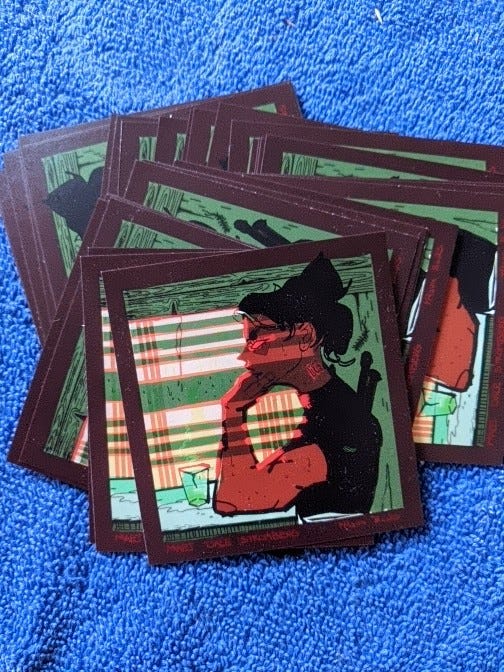
tRaum Books, the publisher of Maej, sent me pictures of stickers they’ve printed up featuring troubled warrior Aunhma Cairnhand, a character from the novel. If you buy such books from tRaum as their pocket-sized special editions, an Aunhma sticker goes into the box too.
Ebook editions of some of my books, such as Melancholic Parables and Gyre, are now available on Bookshop.org, for anybody hunting for non-Amazon options.
In a couple of previous Seldoms, I mentioned that a short story of mine would come out in a certain literary magazine. Due to creative differences regarding how the story was to be edited, that fell through. Once again finding myself with the story on my hands, I’ve not yet decided what to do with it. Maybe I should post it to this newsletter?
Recent reads
Allow me to share some excellent books I’ve read since the last Seldom:
This Is How You Lose the Time War by Amal El-Mohtar & Max Gladstone: A story told with wondrous panache, with delicate poetry and arch incisiveness. At the core of it all, an incandescent love for the ages. (Literally.)
Countess by Suzan Palumbo: This sci-fi retelling of The Count of Monte Cristo through a postcolonial lens is a propulsive space opera vibrating with indignation at the abuses and hypocrisies of our rapacious history and present.
Rakesfall by Vajra Chandrasekera: A speculative novel so audaciously broad in its ambition that it makes me regret having overused the descriptor “kaleidoscopic” on other books. Cosmic delirium in book form.
Hillbilly Grit by Marynell Autry: Historical fiction with an edge. The story leaps off the page with arresting complexity and darkness. Autry writes with a formidable precision and richness; not a word is out of place.
Escape from Incel Island by Margaret Killjoy: A dashing, cutthroat operative; an island full of incel douchebags duped into quarantine; a dastardly double-cross; and a trail of bodies and of wicked one-liners. Naughty fun.
I’d also like to share some fine short fiction I’ve encountered online:
“Care and Feeding” by Kate Broad (in The Rumpus): An emotionally wrenching picture of the fearful uncertainty which confronts us as we set about hoping to live.
“Reincarnated Into the MMORPG That Caused My Son to Flunk out of Life” by E. P. Tuazon (in Miracle Monocle): An abduction into a virtual world which promises escape but also forces a necessary confrontation.
“The Tender Axis” by Lindsey Drager (in The Kenyon Review): A sombre tale that steps through time to interweave creation, love, loss, fate, and Mary Shelley.
“House Hunting” by Mary Heitkamp (in Electric Literature): A thoroughly entertaining send-up of cutthroat bourgeois ambitions.
“The Song of the Bow” by Bee Sacks (in Electric Literature): A marvellously crafted meditation on desire and disappointment at opposing poles of permissiveness.
“Heaven and Earth, Horatio” by Steve Edwards (in Necessary Fiction): A brief elegiac piece which construes some kind of significance from senseless death.
“The Brothers Wham!” by Megan Giddings (in The Masters Review): I never would have imagined someone could squeeze magic out of Wham!, but these three pieces are delightful.
“Work, First” by Catherine Kim (in The Masters Review): The personal cost of a medical breakthrough when one’s world is in the grip of political terror.
“Love Story in Colored Glass” by Phoenix Alexander (in Uncharted): A love that splits across realities that shatter like glass. Fine poetic spec-fic.
“The Observer’s Cage” by Marguerite Sheffer (in The Offing): On the discovery of a turbulent universe and the turbulence of loving too fully.
“The Journal of Anodyne Historical Documents” by Peter M. Kazon (in The Kenyon Review) – A hermit-crab piece, in form a personal encyclopedia, at heart a rumination on love lost to AIDS.
“Heart” by David James Poissant (in The Cincinnati Review): A flash piece of surprising poignancy, the sort to spur a think and then a rethink.
Something old
In case you’re interested, back in November 2022, sci-fi magazine Planet Scumm published my short story “Pharinexin”. Read the story here. (It’s also included in my short fiction chapbook Váried Parályses.)
Strangely enough, the germ of the story came as I pondered how tricky the legacy of colonialism must be for postcolonial people. I am reminded of how Gandhi, a lawyer by training, was said to have found the English system of law far superior to law as it had existed in India before colonialism. If I recall correctly, he thought it was more equitable.
Yet when a journalist asked Gandhi, “What do you think of Western civilization?” he is said to have answered, “I think it would be a good idea.”
Behind this quip, of course, must have lain a deep and painful awareness of how—let’s not even say “uncivilized”, but—how barbarically the Indian people were treated by their colonisers. See, for example, the Al Jazeera article “How British colonialism killed 100 million Indians in 40 years”—or, for the abridged version, just re-read that headline.
I can imagine a given Indian person feeling, most ardently, that this horrid legacy disqualifies anything English in origin from deserving to persist in their country. They might want to purge Indian law of its English influence. They might wish to purge the English language itself. This urge would be humanly understandable.
Yet if access to this language, or to this system of law, improves life for Indians, then another Indian person might resist the idea of throwing them out. They might even argue that the heavy toll India paid over the decades entitles it to use any ancillary benefits of colonialism as it sees fit.
It’s a complicated question with no easy answers. It also isn’t necessarily my story to tell. I began to woolgather on how the central complexity and tension might be transmogrified into an entirely different scenario, and eventually I wrote “Pharinexin”.
Maybe you’ll like it. Here’s that link again.
Sharing is caring
If you know anyone who might like to sign up for this newsletter, I hope you will tell them about it.
If you yourself would like to subscribe, here’s a button: